
Choosing a cosmetic provider is difficult because almost every provider says the same things. Everyone claims to be professional, experienced, and results-focused. Those words cost nothing to write and tell you nothing useful. This page tries to be more concrete: it describes what is actually done differently, and — more usefully — sets out the specific things you should verify with any whitening provider before booking, including this one.
Teeth Whitening sits in a part of the market with low barriers to entry. Anyone can buy equipment and begin offering treatments. That produces a wide spread in standards, and it is genuinely hard for a member of the public to tell from a website which end of that spread they are looking at. The most useful thing a provider can do is tell you what questions to ask, and then answer them.
What follows covers training and insurance, why a specialist focus matters, what the pre-treatment consultation actually achieves, the approach taken to comfort, and what happens after your appointment. It closes with a checklist you can apply to any provider you are considering.
If you would rather start with the practicalities, the services page explains the appointment step by step, the prices page sets out the cost and what it includes, and the results page covers what a realistic outcome looks like.
Trained and Insured Practitioners
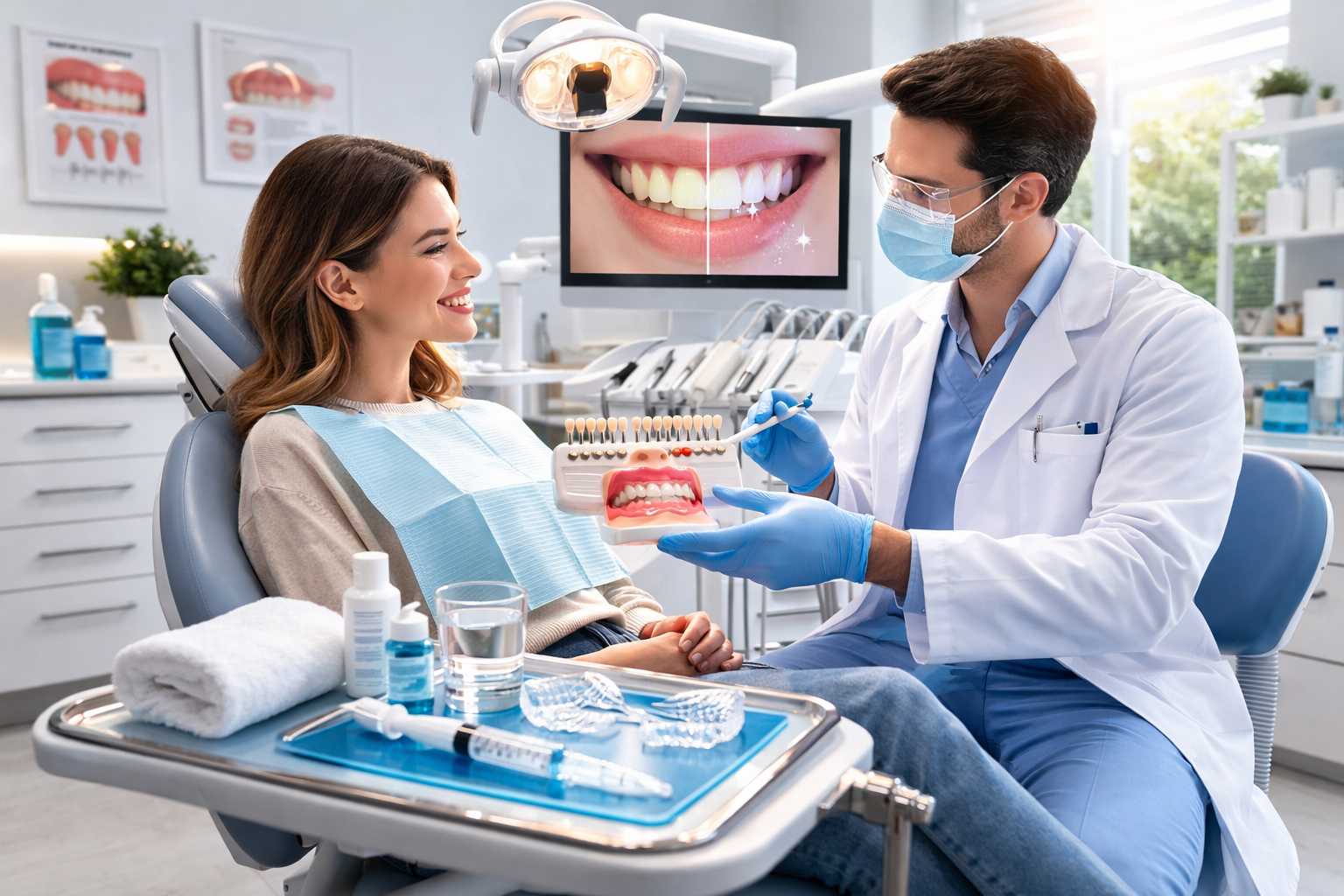
Treatment is carried out by practitioners who have been properly trained in cosmetic whitening and who hold appropriate insurance for the work they do. Both of those things are ongoing costs rather than one-off boxes to tick, and both are among the first things an underpriced operator quietly drops.
Why Training Shows Up in the Result
The visible difference training makes is in the unglamorous parts of the appointment. Protecting the gum line properly. Drying the tooth surface so the treatment makes even contact rather than sitting on saliva. Working systematically across the whole smile line rather than concentrating on the two front teeth. Judging when a stage has run long enough. Recognising when someone in the chair is uncomfortable before they say so.
None of this is visible to you as it happens, and all of it determines whether your result is even. The characteristic tell of an untrained application is a patchy finish — noticeably lighter front teeth, or a pale band where a product made uneven contact. The eye registers that as artificial without being able to say why.
Why Insurance Matters to You
Insurance is not about expecting problems. It is about what happens in the small number of cases where something does not go as planned. An uninsured provider offering cosmetic treatment has transferred all of that risk to you without telling you. If something goes wrong, you have no meaningful recourse.
This is a reasonable thing to ask about directly, and a properly insured provider will not find the question awkward. Any hesitation in answering it is informative.
Recognising When to Refer On
An important part of training is knowing the limits of what cosmetic whitening should be used for. A practitioner who can identify that a single dark tooth suggests discolouration from within, that inflamed gums need attention before anything cosmetic, or that a presentation warrants a dentist's opinion is protecting you. A practitioner who treats everyone who books is not assessing anyone.
A Specialist Focus Rather Than a Sideline
Teeth Whitening is offered widely as an add-on — in beauty salons, mobile aesthetics businesses, and alongside a long list of unrelated treatments. There is nothing inherently wrong with that model, but it does mean whitening is one of many things being done rather than the thing being done.
This service concentrates on whitening specifically. The practical consequence is repetition: the same treatment carried out consistently, on a wide range of starting shades and staining types, rather than occasionally between unrelated appointments. Repetition is how judgement develops — knowing what a particular pattern of staining is likely to do, recognising when someone's expectations do not match what their teeth will deliver, and understanding how to stage an appointment for someone who is nervous.
What Specialisation Changes in Practice
Having seen a wide range of starting points makes it easier to say honestly what a particular set of teeth is likely to do, rather than quoting a generic promise.
The same procedure performed regularly is performed more consistently. Evenness of application is largely a function of practised routine.
Knowing precisely what whitening does not address makes it easier to recognise when the honest answer is that a dentist is the right person to see.
A Note on Comparisons With Dental Practices
Cosmetic whitening and dentistry are different things, and it would be misleading to present one as a cheaper substitute for the other. A dental practice provides clinical assessment, diagnosis, and treatment of dental conditions. Cosmetic whitening addresses the appearance of surface staining and nothing else. If you have a dental problem, a dentist is the correct person to see, and no cosmetic service should suggest otherwise. What a specialist cosmetic service offers is a focused treatment for an appearance concern, delivered by someone who does it regularly.
The Consultation That Comes First
Every appointment begins with a pre-treatment consultation before anything is applied. This is included in the price rather than charged separately, and it is not a formality. It is the part of the service that decides whether your outcome is predictable.
What you are hoping for, in your own words, and whether you are working towards a particular date. Vague goals produce vague satisfaction.
Sensitivity, existing restorations, recent dental work, and the habits contributing to staining in the first place.
A visual check of teeth and gums to identify anything that should be addressed by a dentist before cosmetic treatment.
A plain explanation of what is likely to change, what will not, and whether whitening is the right thing for you at all.
Why Expectation-Setting Matters More Than It Sounds
Most dissatisfaction with cosmetic treatment traces back to a mismatch between what someone expected and what was ever achievable. The treatment performed correctly, and the person was still disappointed, because nobody explained beforehand that the crown on their upper left would stay exactly the shade it was.
Discussing this before you book is not managing your expectations downward as a defensive measure. It is giving you the information you need to decide whether to spend the money at all. Some of those conversations end with someone deciding not to proceed, and that is a legitimate outcome.
Being Told No
There are circumstances where the responsible answer is to decline. Untreated decay. Sore or bleeding gums that have not been assessed. Very recent dental work still settling. A single tooth darkened from within. Expectations that whitening simply cannot meet. In each case the appropriate course is to say so and, where relevant, suggest seeing a dentist first.
A provider who has never turned down a booking is not conducting assessments. Willingness to lose a sale by giving an honest answer is one of the few reliable quality signals available to you in this sector.
A Comfort-First Approach
Whitening has a reputation for sharp, sudden sensitivity, and that reputation is the main reason people who have tried it once do not try again. Comfort is treated here as a design consideration rather than something to endure.
Peroxide-Free Treatment
Peroxide is the ingredient most commonly associated with the sensitivity people describe. A peroxide-free approach is used instead, aiming to lift the appearance of surface staining rather than drive an aggressive reaction through the tooth. Most people find the session comfortable throughout.
Staged Application With Checks
The treatment is applied in stages rather than as one continuous application, and you are asked how you are finding it between each one. If something feels uncomfortable, a stage can be shortened or dropped. Nothing about the session is fixed in a way that overrides how you actually feel during it.
Honest About the Minority
It would be easy to claim nobody ever experiences any sensitivity. That is not accurate. A minority of people notice mild, short-lived sensitivity afterwards, most often to cold, and it typically settles within a day. Saying so in advance means that if you do notice something, you recognise it as ordinary rather than worrying about it.
Treatment in Your Own Home
For people who find clinical environments uncomfortable, being treated at home makes a genuine difference. There is no waiting room, no unfamiliar setting, and no sense of being processed. Apprehensive first-timers in particular tend to find their own sofa considerably easier than a treatment chair.
Support That Continues After the Appointment
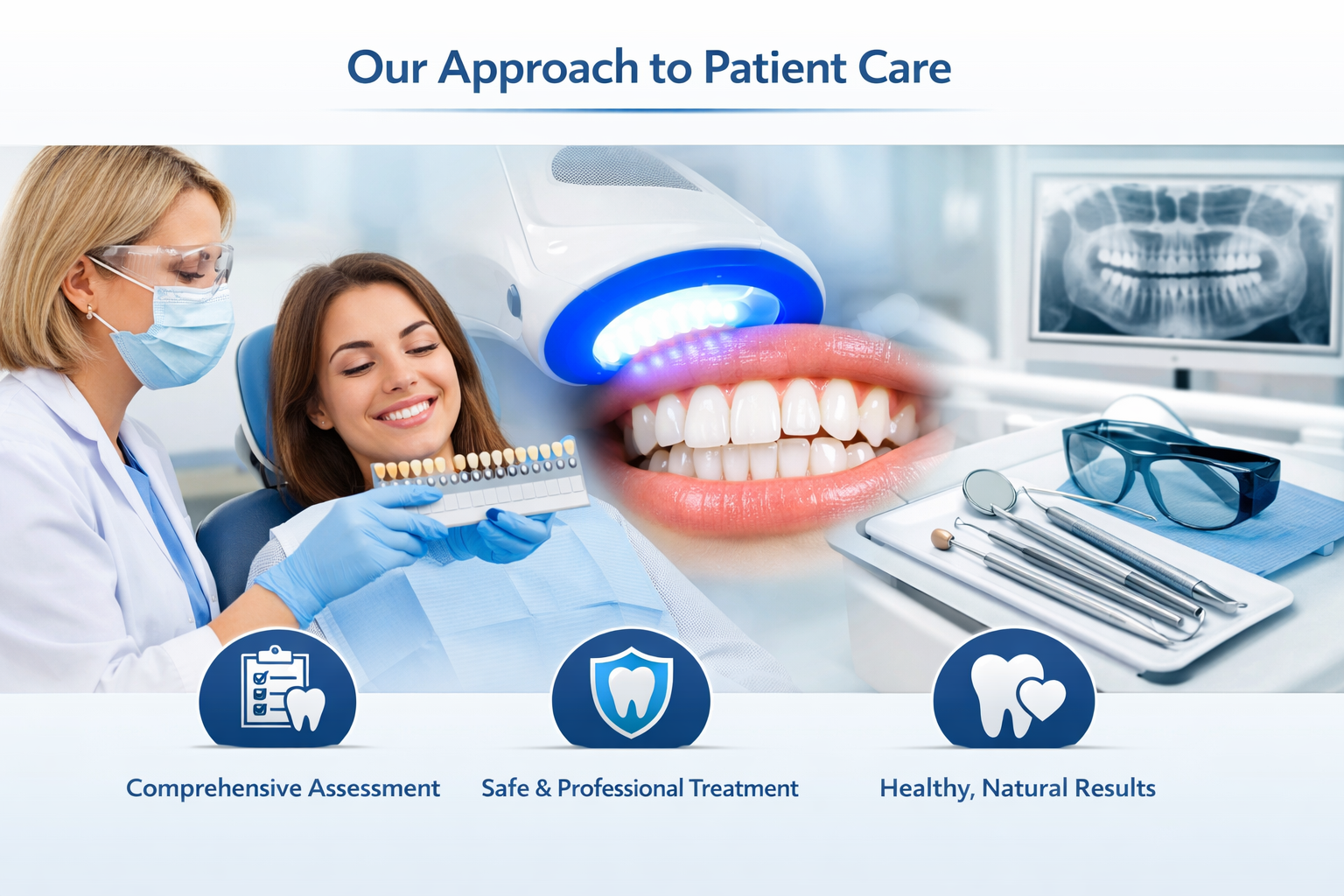
A whitening service that ends the moment payment is taken is only delivering half of what determines your result. The forty-eight hours after treatment carry disproportionate weight, and most of what happens during that window is down to what you were told before you were left to it.
Written Aftercare, Not a Verbal Summary
The aftercare guidance is provided in writing rather than explained once at the door and forgotten by the evening. It covers the strict forty-eight hour window, what to avoid and what is safe, and the everyday habits that determine how long the result holds. Having it written down matters because the guidance needs to be consulted the following day, not recalled from a conversation.
Someone to Ask
Questions arise afterwards. Whether a particular food is acceptable on day two. Whether mild temperature sensitivity is normal. When it would be reasonable to consider a top-up. Having a point of contact for these is part of the service rather than an extra.
Your Shade Record
Your starting and finishing shades are recorded against a standard guide. This gives you an objective reference rather than relying on memory — useful months later when you are judging whether your result has genuinely faded or whether you have simply grown used to it. It also provides a factual basis for any conversation about your result rather than two differing recollections.
Honest Guidance on Top-Ups
There is no schedule to keep to and no advantage in whitening more often than your teeth actually warrant. Advice here is that top-ups are worth considering when a result has faded to a point that bothers you, not on a routine cycle designed to generate repeat bookings.
Practical Things That Make It Easier
Treatment Comes to You
Appointments take place at your address. Nothing specialised is needed — a comfortable chair, reasonable light, a power socket, access to a sink, and a quiet hour. Equipment is brought, set up, and cleared away as part of the appointment, and the space is left as it was found.
Time Saved Beyond the Hour
A one-hour appointment elsewhere is rarely a one-hour commitment. Travel, parking, and waiting frequently double or triple it. Removing the journey is often the difference between fitting treatment into a working week and postponing it indefinitely.
Appointment Times That Fit Around Work
Flexible scheduling exists because most people cannot take a weekday afternoon off for a cosmetic appointment. Availability varies, so confirm what suits you when you enquire.
Two People, One Visit
Two people can be treated during the same visit, which lowers the cost per person and means both follow the aftercare window together — considerably easier in practice than one person avoiding the tea round alone. The prices page sets out how this is structured.
A Complete Price Before You Commit
You are told the full cost before booking, including travel within the covered area. There is no separate consultation fee and no charge appearing once you are already in the chair.
Hygiene and Single-Use Items
Items that should be single-use are single-use, and equipment is cleaned between appointments. This is a basic expectation rather than a distinguishing feature, but it is worth confirming with any provider you consider, particularly in a mobile setting.
What to Verify With Any Provider
This checklist applies to every whitening provider, including this one. Comparing the same questions across providers is far more informative than comparing their websites, which are all written by people trying to sound reassuring.
| What to Ask | A Good Answer | A Warning Sign |
|---|---|---|
| Training | Specific training named, explained without hesitation | Vagueness, or deflection to "years of experience" |
| Insurance | A clear yes, with the cover explained | Avoiding the question or changing the subject |
| Assessment | A consultation before treatment, included in the price | No assessment, or a separate fee for it |
| Expectations | Specific to your teeth, including what will not change | The same dramatic promise offered to everyone |
| Total price | A complete figure given before you commit | "From" pricing, or costs revealed later |
| Aftercare | Written guidance plus a point of contact | Nothing provided, or a verbal summary only |
| Before-and-after images | Own clients, matched lighting, no retouching | Stock imagery, or unwillingness to say |
| Turning work away | Clear examples of when they decline to treat | Everyone is suitable, always |
How the Answers Should Feel
Good answers are specific and frequently include limits. "Your staining looks largely surface-level so you should see a clear change, but that filling will stay the shade it is" is a good answer. "Everyone gets fantastic results" is not an answer — it describes a marketing position rather than your teeth.
Be attentive to whether someone is willing to tell you something you would rather not hear. That willingness is difficult to fake and hard to find, and it is worth more than any amount of reassuring copy.
What Happens on the Day, Start to Finish
Knowing the shape of the appointment in advance removes most of the apprehension people bring to a first session. Nothing below should come as a surprise on the day.
- Arrival and setup
- The practitioner arrives at the agreed time, introduces themselves, and sets up in the room you have chosen. Setup is quick and requires nothing from you beyond showing them where to work.
- The consultation
- A conversation and a visual check of your teeth and gums before anything is applied. This is when anything that has changed since booking should be mentioned — a new twinge, a recent filling, or a mouth ulcer.
- Shade record
- Your starting shade is recorded against a standard guide. This takes a moment and provides the reference point against which your result is measured afterwards.
- Preparation
- Your lips and cheeks are gently held clear and the gum line is protected. Teeth are wiped and dried so the treatment makes even contact rather than sitting on saliva or plaque.
- Staged application
- The treatment is applied across the visible smile line and activated for a set period, then removed and reapplied — typically three stages across the hour. You are asked how you are finding it between each one.
- Assessment
- The treatment is removed for the final time, teeth are rinsed and cleaned, and your finishing shade is recorded against the same guide used at the start.
- Aftercare briefing
- A short, practical explanation of the forty-eight hour window, handed over in writing. This is the point to ask anything you are unsure about.
- Clearing away
- Equipment is packed up and the space is left as it was found. The whole appointment runs to approximately an hour.
There is nothing you need to bring, and nothing you need to do during the activation periods beyond sitting comfortably. Most people rest, listen to something, or simply wait. You can indicate at any point if you would like to pause.
Where Whitening Fits Alongside Dental Care
Cosmetic whitening complements dental care; it does not substitute for any part of it. Being clear about the relationship between the two prevents the most consequential misunderstandings.
See a Dentist First If Anything Is Outstanding
If you have not had a check-up recently, have it before whitening rather than after. It confirms there is nothing untreated, and it means any decay or gum problem is dealt with by the right person. Whitening applied over an unresolved dental issue does not address the issue and can make an uncomfortable situation worse.
Have the Clean Before, Not After
A professional scale and polish removes hardened deposits that no home routine can shift. Doing that first gives whitening a cleaner surface to work on, which produces a better and more even result for exactly the same fee. Sequencing it the other way round wastes part of what you have paid for.
Time Restorative Work Around It
If a filling, crown, or veneer on a front tooth is due to be replaced, discuss the sequence with your dentist. Whitening first means new work can be matched to your finished shade rather than your previous one. Doing it in the wrong order can mean paying to redo the restoration.
Whitening Is Not a Health Treatment
It addresses the appearance of surface staining and nothing else. It does not clean teeth in a clinical sense, treat any condition, or reduce your need for routine dental care. Keeping regular appointments matters just as much afterwards as before.
The Concerns People Raise Before Booking
The same handful of worries come up repeatedly, and they deserve direct answers rather than reassurance. Each is addressed plainly below.
"Will it damage my enamel?"
This is the most common concern and usually stems from stories about aggressive whitening. The approach here is peroxide-free and aims to lift the appearance of surface staining rather than drive a strong reaction through the tooth. That said, the honest general point is that problems in this sector overwhelmingly arise from unsupervised overuse — repeated shop-bought kits used more often or for longer than the instructions state — rather than from a single properly applied appointment.
"Will it look obviously fake?"
The intended outcome is teeth that look clean and healthy rather than conspicuously white. Where results look artificial, the cause is usually unevenness rather than brightness — lighter front teeth against darker canines, which the eye registers as wrong without identifying why. Applying treatment systematically across the whole smile line is what avoids this.
"Is it going to hurt?"
Most people find the session comfortable throughout. A minority notice mild, short-lived sensitivity afterwards, usually to cold, which typically settles within a day. Staging the application with checks in between means anything uncomfortable can be adjusted while you are still in the chair rather than endured to the end.
"Am I too old for this to work?"
Age is not a barrier, though it does affect what is achievable. Enamel thins gradually across a lifetime, allowing more of the naturally yellower dentine beneath to show through. That component is structural rather than staining and does not respond to whitening. Accumulated surface staining, however, responds at any age — and older teeth often carry more of it, so the visible change can be considerable.
"What if I have fillings?"
Tooth-coloured fillings keep the shade they were made in. If they sit in your smile line, whitening the natural teeth around them changes how noticeable they are — potentially making them stand out more than before. This is exactly the sort of thing the consultation exists to identify, and it is far better raised beforehand than discovered afterwards.
"Is a mobile service as good as a clinic?"
The treatment itself is identical; what changes is the setting. The relevant questions are the same ones you would ask anywhere: training, insurance, whether an assessment happens, and what aftercare you receive. Judge a mobile provider on those criteria rather than on the fact that they travel.
Standards to Expect From a Mobile Service
A treatment delivered in your home should meet the same standards as one delivered anywhere else. Because there is no premises for you to inspect, it is reasonable to ask more questions rather than fewer.
Hygiene and Single-Use Items
Anything that should be single-use is single-use and disposed of appropriately. Reusable equipment is cleaned between appointments. Working surfaces are prepared and protected. None of this is distinguishing — it is the baseline — but in a setting you cannot inspect in advance, it is worth confirming.
Identification and Professionalism
You are letting someone into your home. It is entirely reasonable to expect a confirmed appointment time, notification of who will be attending, and identification on arrival. Any provider who finds that expectation unusual is not one to book.
Respect for Your Space
Equipment is brought in, set up, and cleared away as part of the appointment. Surfaces are protected during treatment. Your home is left as it was found. This should not need stating, and it is stated because it is a real differentiator in mobile services.
Clear Timing
An appointment window that is actually kept to, with notice if anything changes. A vague arrival time that stretches across an afternoon is not a mobile service adapting to circumstances; it is poor scheduling being passed on to you.
The Same Assessment as Anywhere
A home setting is not a reason to skip the consultation. The same pre-treatment checks, the same shade record, and the same honest conversation about what will and will not change should happen in your living room exactly as they would in a treatment room.
Why Recommendation Matters in This Sector
Cosmetic treatment is unusually reliant on word of mouth, and for good reason. Advertising in this sector is uniformly enthusiastic, and images are easy to manipulate. A recommendation from someone whose result you can see in person, in ordinary light, across a table, is worth more than any amount of marketing.
What a Personal Recommendation Actually Tells You
- You are seeing a real result rather than a photographed one.
- You can ask what the appointment was actually like, including anything uncomfortable.
- You learn whether the result held up over the following months.
- You find out whether the person felt properly informed beforehand.
- You hear how any problem or question was handled afterwards.
What It Means for How a Service Operates
A business that depends on recommendation has different incentives from one that depends on continuous new advertising. Overselling produces disappointed clients who tell people. Rushing appointments produces uneven results that are visible to everyone who sees them. Setting expectations too high produces dissatisfaction even where the treatment went well. The commercial interest and your interest point in the same direction, which is a more reliable foundation than good intentions alone.
Reviews Versus Recommendations
Online reviews are useful but weaker evidence than a personal recommendation, for a straightforward reason: you cannot see the result, you cannot ask follow-up questions, and you cannot verify who wrote them. Read them for patterns rather than for individual verdicts. A recurring theme across many reviews — consistently good communication, or repeated complaints about timekeeping — tells you something real. A single glowing review and a single furious one tell you very little on their own. Pay particular attention to how a provider responds to criticism, since that response is written for everyone to read and reveals a good deal about how a complaint would be handled if it were yours.
When Asking Around
If someone recommends a provider to you, ask the useful questions rather than only whether they were happy. Was there a proper consultation? Were they told what would not change? Did they receive written aftercare? How long did the result last? Would they use the same provider again? Those answers tell you considerably more than a general endorsement.
Questions About the Service
Judge Any Provider on the Same Terms
Everything on this page is stated as something you can verify rather than something you have to take on trust. Trained practitioners. Appropriate insurance. A consultation before treatment, included in the price. Honest expectations, including a willingness to say no. A comfortable, staged appointment. Written aftercare and someone to ask afterwards. A complete price before you commit.
Apply the same questions to every provider you are considering. The ones worth booking with will answer them readily and will not mind being asked. That comparison will tell you far more than any website, including this one.
The services page covers what the appointment involves, the results page explains what a realistic outcome looks like, the prices page sets out the cost, and the contact page explains what to include in an enquiry.