Before-and-after images are the most persuasive thing any whitening provider can show you, and also the easiest thing to present misleadingly. Lighting, camera angle, exposure, and even how wide someone opens their mouth can exaggerate a modest change into a dramatic one. This page is written to help you read results properly — your own and anyone else's — rather than simply to impress you.
The Teeth Whitening service is built around visible change within a single appointment. You are not waiting days to find out whether it worked, and you are not returning for a series of sessions before anything happens. The treatment is carried out, and the difference is there when you stand up. For most people that immediacy is the appeal.
What follows covers what a typical result actually looks like, how change is measured objectively rather than by impression, the factors that make one person's outcome different from another's, and the honest limits of what surface whitening can achieve. It also covers longevity, because a result that looks excellent on the day and fades within a fortnight is not a good result.
Throughout, the emphasis is on realism. A provider who promises everyone the same dramatic outcome is either not assessing individuals properly or is describing their photography rather than their treatment. Teeth Whitening produces a real, visible, worthwhile improvement for most people. It is not a transformation into a shade that natural adult teeth do not occupy.
What a Typical Result Actually Looks Like
The most accurate description of a good Teeth Whitening result is that teeth look clean, fresh, and healthy rather than conspicuously white. People notice that you look well. They do not usually identify what changed. That is the outcome most people actually want once they think it through, even when they arrive asking for something more extreme.
In practical terms, the change is a reduction in the appearance of accumulated staining. Yellowing from years of tea and coffee lifts. Grey-brown surface dullness reduces. Teeth look less tired. The shape, alignment, and position of your teeth are entirely unchanged, because whitening is a colour treatment and nothing more.
How Change Is Described
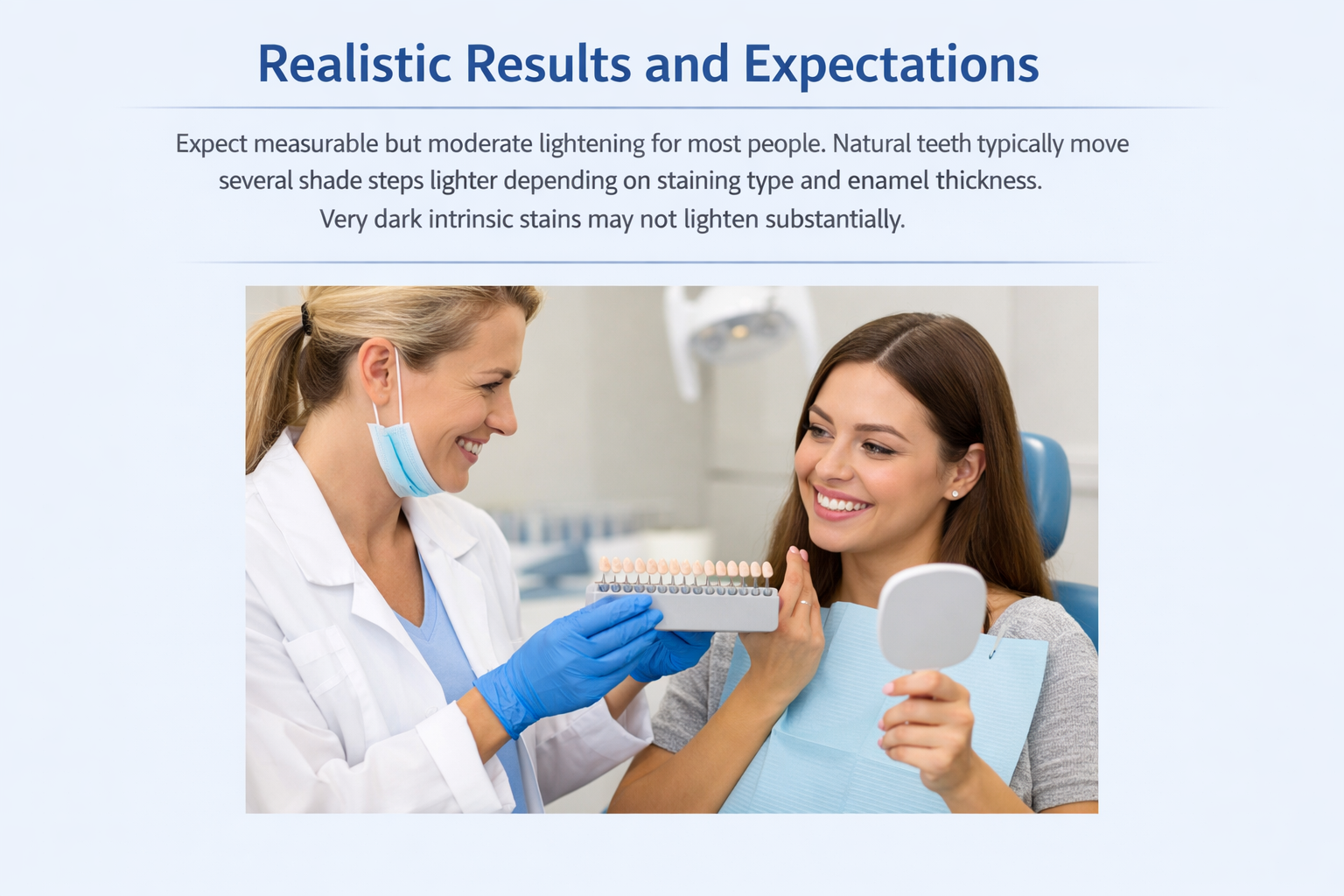
Tooth colour is recorded against a standard shade guide — a physical set of reference tabs arranged from darker to lighter. Your shade is noted before treatment and again afterwards, and the difference between the two is expressed as a number of shade steps. This matters because it converts a subjective impression into something measurable. "It looks a bit brighter" is an opinion. A recorded movement across the guide is a fact.
The degree of movement varies considerably between individuals. Someone with heavy surface staining from years of smoking often shows the most dramatic change, simply because there was more to remove. Someone whose teeth were already fairly light will see a subtler shift, because there was less staining to lift in the first place. Neither outcome is better treatment; they are different starting points.
Why Your Result Will Not Match Someone Else's
- Starting shade — the darker the beginning, the more visible the change.
- Stain type — surface staining lifts well; discolouration from within the tooth does not.
- Enamel thickness, which varies naturally and changes with age.
- How long the staining has been accumulating.
- Whether existing restorations sit in your smile line.
- How closely the aftercare window is followed afterwards.
This is why comparing your own before-and-after against someone else's is rarely useful. The meaningful comparison is between your teeth before and your teeth after, recorded under the same conditions.
Results From a Single Appointment
A common frustration with whitening is the waiting. Tray-based systems and over-the-counter kits require daily use across days or weeks, during which you cannot tell whether anything is working. People abandon those courses part-way through more often than they complete them, and an unfinished course produces an uneven, disappointing result.
This service is structured differently. The treatment is applied and completed within roughly an hour, and the change is assessed at the end of that hour against your recorded starting shade. There is no re-application to book, and no need to attend repeatedly before you see whether it worked for you.
Immediate Versus Settled Appearance
You will see a difference immediately. It is worth knowing that teeth can look slightly different again over the following day or two as they settle and rehydrate naturally — a normal and expected part of the process. The shade recorded at the end of your appointment is the meaningful reference point, and what you see a couple of days later is what you can expect to live with.
This settling period is one more reason to plan an appointment a few days ahead of any event rather than the same morning. It gives the result time to stabilise, and it keeps the aftercare window clear of the occasion itself.
What Happens in That Hour
The treatment is applied across the visible smile line in stages rather than as one continuous application, with the teeth checked between stages. Working in stages is what produces an even result across every tooth in the smile line rather than concentrated change on the two front teeth, which is the characteristic failure of self-applied strips and one-size trays. Evenness is a large part of why a professionally applied result reads as natural.
Before and After Gallery
The gallery below is reserved for genuine before-and-after documentation from completed Teeth Whitening appointments. Each position carries the alt text it will use once a real photograph is added, so the page is ready for imagery without any structural change. Until real images are in place, no photograph is shown — a placeholder is honest, and a stock image of someone else's teeth is not.
How to Read a Before-and-After Pair Critically
Whether you are looking at this gallery or any other provider's, the same questions apply. Was the lighting the same in both photographs? A brighter, cooler light source makes teeth read as whiter without any treatment having occurred. Is the camera at the same distance and angle? Is the mouth open to the same degree — a wider smile shows more tooth surface and reads differently. Has the image been retouched, brightened, or had its contrast raised?
Honest documentation controls for these variables. Standardised distance, consistent lighting, the same framing, and no post-processing beyond cropping. If a provider cannot tell you how their images were captured, treat the comparison cautiously.
The Factors That Shape Your Outcome
Understanding what drives variation between individuals removes most of the disappointment people occasionally feel about cosmetic treatment. Very little of it is random.
Type of Staining
This is the largest single factor. Extrinsic staining sits on the outer surface of the enamel and is deposited by food, drink, and smoking. It responds well, because it is on the outside of the tooth where the treatment works. Intrinsic discolouration originates within the tooth structure — from childhood illness, certain medications taken while teeth were forming, or trauma to a specific tooth — and surface treatment reaches it poorly or not at all.
Most adults have predominantly extrinsic staining, which is why most people see a worthwhile change. Where discolouration is substantially intrinsic, the honest answer is that whitening is the wrong tool, and a dentist is better placed to discuss the options.
Starting Shade
Someone starting from heavily stained teeth typically sees more visible change than someone whose teeth are already fairly light — there is simply more staining available to lift. Paradoxically, people with lighter starting shades sometimes report the greatest satisfaction, because the finished result sits closer to the natural bright end of the range.
Enamel Thickness and Age
Enamel is semi-translucent, and the dentine beneath it is naturally yellower. Enamel thins gradually across a lifetime, which allows more of that underlying colour to show through. This part of tooth colour is not staining and does not respond to whitening. It is the main reason adult teeth cannot be returned to the shade they were in adolescence, regardless of the treatment used.
Existing Dental Work
Crowns, veneers, bridges, and tooth-coloured fillings retain the shade they were manufactured in. If a restoration sits in your smile line, whitening the natural teeth around it changes the relationship between them. Where the restoration was matched to previously darker teeth, it can become more noticeable afterwards, not less. This is important to discuss before booking rather than after.
How Well the Aftercare Is Followed
The forty-eight hours after treatment carry disproportionate weight. Enamel is temporarily more receptive to colour during that window, so strongly pigmented food and drink have an outsized effect. Two people with identical treatment and identical starting shades can end up in visibly different places a week later purely on the strength of what they consumed on day one. The services page sets out the aftercare guidance in full.
What Teeth Whitening Will Not Change
Being explicit about limits is not a disclaimer buried in small print — it is the part of the conversation that determines whether you are pleased afterwards. Every item below is something whitening genuinely does not do.
Crowns, veneers, bridges, and tooth-coloured fillings keep their manufactured shade. Only natural tooth surface responds.
Whitening is a colour treatment. Chips, gaps, crowding, and tooth position are unaffected and need different treatment entirely.
Decay, gum disease, and infection are not treated by whitening and must be addressed by a dentist beforehand.
Discolouration originating inside the tooth — from trauma or medication during development — responds poorly to surface treatment.
Everyone has an underlying tooth colour. Whitening removes staining layered over it; it does not replace the colour beneath.
Nothing makes teeth stain-proof. New staining begins accumulating from the day after treatment at the usual rate.
Where a Dentist Is the Right Referral
If your concern is a chipped edge, a gap, crowding, a single dark tooth, or a restoration that no longer matches, whitening is not the answer and no amount of it will become the answer. Those are restorative and orthodontic questions. A provider who recognises the distinction and says so is being useful, even though it means declining your booking.
Illustrative Outcome Scenarios
The scenarios below are written as general illustrations of how different starting points lead to different outcomes. They are explanatory examples rather than accounts of identified individuals, and they are included to show the range of realistic results rather than to present a best case.
Years of daily coffee produce even, moderate surface staining across the smile line. This responds well, and the change is usually clearly visible because the staining is extrinsic and evenly distributed. The result tends to look like a return to how the teeth looked several years earlier.
Tobacco staining is often the most dramatic to reduce, simply because there was the most to lift. The important condition is that the habit has actually stopped. Continuing to smoke reintroduces staining immediately and shortens the result considerably.
Someone whose teeth are only mildly dulled sees a subtler change, because there is less staining available to remove. The finished shade may still be the lightest of any scenario here, but the before-and-after difference looks smaller.
The natural teeth lighten and the crown does not, which changes how noticeable that crown is. Discussed beforehand, this is a planned trade-off. Discovered afterwards, it is an unwelcome surprise — which is precisely why it belongs in the consultation.
Where one tooth is noticeably darker than its neighbours, the cause is usually internal rather than surface staining. Whitening lightens the surrounding teeth and can make the difference more apparent. A dentist's assessment should come first.
A good result on the day, followed by red wine and coffee the same evening, produces a visibly weaker outcome within a week. This is the most common cause of disappointment and the most avoidable.
How Long Results Last
Longevity is where whitening claims most often become unrealistic. No treatment makes teeth permanently resistant to staining, because the mechanism that stained them originally continues to operate. What a good result offers is a meaningful period before new staining becomes noticeable again, and that period is driven mainly by your habits.
Why There Is No Single Answer
Anyone who quotes an exact duration for everyone is guessing. A non-smoker who drinks one coffee a day, brushes twice, and cleans between their teeth will hold a result far longer than a heavy tea drinker who smokes. The treatment is identical; the environment it has to survive is not.
| Habit | Effect on Longevity | Practical Adjustment |
|---|---|---|
| Smoking or vaping | Shortens results substantially | Stopping is the single most effective change |
| Frequent tea or coffee | Gradual return of yellowing | Drink in one sitting; rinse with water afterwards |
| Red wine | Pigment plus acidity, a strong combination | Alternate with water; avoid brushing immediately |
| Inconsistent brushing | Surface deposits settle and harden | Two minutes, twice daily, soft-bristled brush |
| Skipping interdental cleaning | Staining appears between teeth first | Floss or interdental brushes once daily |
| No dental check-ups | Hardened deposits accumulate unchecked | Keep routine appointments and hygienist visits |
Noticing the Fade
Because new staining accumulates slowly, almost nobody notices it happening. People notice it in a photograph, or when they see an older picture. Your recorded starting and finishing shades are useful here, giving an objective reference rather than relying on a memory of how things looked months ago.
Top-Up Appointments
A top-up follows the same format as the original appointment, including the same forty-eight hour aftercare window afterwards. There is no schedule to keep to and no advantage in whitening more often than your teeth actually warrant. When the result has faded to a point that bothers you, that is the right moment to consider it.
Why Teeth Discolour in the First Place
Understanding what produced the staining explains why results vary so much between individuals. Tooth colour is not a single property; it is the combined effect of two different layers behaving in two different ways.
The Two Layers That Determine Colour
The outer layer is enamel — hard, dense, and semi-translucent rather than opaque white. Beneath it lies dentine, which is softer, more porous, and naturally yellow. What you perceive as tooth colour is dentine viewed through enamel, modified by whatever has accumulated on the enamel surface. This is why two people with identically clean teeth can still have visibly different natural shades: their enamel thickness and translucency differ.
Enamel thins gradually across a lifetime through ordinary use — chewing, brushing, and exposure to dietary acids. As it thins, more of the yellower dentine shows through. This is a structural change rather than a stain, and no surface treatment reverses it. It is the single most misunderstood aspect of tooth colour, and the reason adult teeth cannot be returned to their adolescent shade.
Extrinsic Staining: The Part That Responds
Extrinsic staining sits on the outside of the enamel. Enamel appears smooth but has a microscopically textured surface, and pigments from food, drink, and smoke lodge in that texture and accumulate. Coffee and tea contribute tannins; red wine adds pigment alongside acidity that temporarily softens the surface; tobacco deposits particularly tenacious yellow-brown residue.
This is the staining that Teeth Whitening addresses, and it is why most adults see a worthwhile result. The great majority of everyday discolouration in adults is extrinsic, built up gradually over years of ordinary habits.
Intrinsic Discolouration: The Part That Does Not
Intrinsic discolouration originates within the tooth structure itself. Common causes include certain medications taken while teeth were still forming in childhood, illness or high fever during tooth development, excessive fluoride exposure in early years, and trauma to a specific tooth that affected the tissue inside it.
Because this discolouration sits beneath the enamel rather than on it, surface treatment reaches it poorly. A single tooth noticeably darker than its neighbours is the classic presentation and almost always warrants a dentist's assessment, since the cause matters considerably more than the appearance.
Why the Distinction Matters to You
Most people have a combination: predominantly extrinsic staining layered over a natural base colour that has gradually deepened with age. Whitening removes the layer that can be removed and leaves the rest. When someone is disappointed with a whitening result, the usual explanation is that a larger proportion of their discolouration was intrinsic or age-related than either party recognised beforehand. A proper assessment before treatment is what catches this in advance.
How Results Compare Across Whitening Methods
People weighing up options generally want to know how the outcome of a professionally applied appointment compares with the alternatives. The differences show up less in the theoretical maximum each method can achieve and more in evenness, reliability, and whether the course is actually completed.
| Method | Time to Visible Result | Evenness | Main Risk to the Outcome |
|---|---|---|---|
| Professional appointment | Within a single hour | Managed across the full smile line | Aftercare not followed in the first 48 hours |
| Custom tray systems | Days to weeks of nightly use | Good, if worn consistently | Course abandoned part-way through |
| Over-the-counter strips | Weeks, if completed | Frequently patchy; strips crease | Uneven coverage and gum contact |
| One-size boil-and-bite trays | Weeks, if completed | Poor; gel migrates and pools | Gum irritation and blotchy results |
| Whitening toothpaste | Minimal shade change | Even, but very limited | Abrasive formulas used long-term |
Completion Rates Matter More Than Maximums
A method's theoretical potential is largely irrelevant if people do not finish the course. Home-based systems require sustained daily commitment, often for several weeks, with no visible reward for the first stretch. That combination produces high abandonment, and a partially completed course delivers a partial, uneven result — sometimes more noticeable than the original staining.
A single supervised appointment eliminates that variable entirely. The treatment is completed in one sitting by someone else, so there is no course to abandon and no daily decision to get wrong. For a great many people this is the practical difference between a result and an intention.
Evenness Is What Reads as Natural
The characteristic tell of a self-applied result is uneven coverage: the two front teeth noticeably lighter than the canines, or a pale band across the middle of each tooth where a strip made contact. The eye registers this as artificial even when it cannot identify why. Applying treatment systematically across the whole smile line in stages is what produces the uniform finish that simply reads as clean teeth.
The First Week, Day by Day
Knowing roughly what to expect across the first week removes a great deal of unnecessary worry, particularly for first-timers who are unsure whether what they are noticing is normal.
- The day of treatment
- A visible change at the end of the appointment, with your finishing shade recorded. Some people notice teeth feeling slightly more aware of temperature during the evening. The aftercare window begins immediately — water, milk, and pale foods only.
- Day one after
- The strictest part of the aftercare window. Any temperature awareness usually eases. Teeth may look very slightly different from how they appeared in the chair as they rehydrate naturally, which is expected rather than a sign of fading.
- Day two after
- The aftercare window closes at the end of this day. The result has settled and this is the fair moment to judge it. A good point to take your own comparison photograph under the same lighting as the original.
- Days three to five
- Normal diet resumes. Reintroduce coffee, tea, and red wine thoughtfully rather than immediately returning to previous habits — rinsing with water afterwards is a small change worth building in now.
- Day six and beyond
- The result is fully settled and everyday maintenance takes over: two minutes of brushing twice daily, interdental cleaning once daily, and water through the day. From here, longevity is determined by habit rather than by anything to do with the treatment.
Recording Your Own Before and After
Many people want their own comparison photographs, which is entirely reasonable. Getting a genuinely useful pair requires a little care, because casual phone photographs taken in different rooms at different times of day tell you very little.
Practical Guidance
- Use the same location and the same light source for both photographs.
- Take the "before" in daylight rather than under warm indoor lighting, which yellows everything.
- Hold the camera at the same distance and height both times.
- Show the same amount of tooth — a natural, relaxed smile rather than a forced one.
- Turn off filters, beauty modes, and automatic enhancement.
- Do not edit brightness or contrast afterwards.
- Photograph the "after" two days later, once the result has settled.
A pair taken this way is genuinely informative and remains a useful reference months later when you are deciding whether a top-up is warranted.
Questions Worth Asking Before You Book Anywhere
These questions apply to any whitening provider, not only this one. The answers tell you a great deal about how seriously results are documented and how honestly expectations are being set. A provider who welcomes the questions is generally a provider worth booking with.
About Their Documentation
- Are your before-and-after images of your own clients, or licensed stock photography?
- Were both photographs taken under matched lighting, distance, and framing?
- Has any brightness, contrast, or retouching been applied beyond cropping?
- How long after treatment was the "after" image taken?
- Do you record shade against a standard guide before and after?
About Your Specific Teeth
- Looking at my teeth, is my staining mainly on the surface or from within?
- Do I have any restorations in my smile line that will not change?
- Is there anything you would want treated by a dentist first?
- What degree of change is realistic for someone starting where I am?
- Is there any reason you would recommend against treating me?
What Good Answers Sound Like
A useful answer is specific and includes limits. "Your staining looks largely surface-level, so you should see a clear change, but that filling on your upper left will stay the shade it is" is a good answer. "Everyone gets fantastic results" is not an answer at all — it describes a marketing position rather than your teeth.
Be particularly attentive to whether a provider is willing to tell you something you would rather not hear. Anyone prepared to say that whitening is unlikely to achieve what you are asking for, or that you should see a dentist first, is demonstrating that their assessment is genuine. A provider who has never declined a booking is not assessing anyone.
Questions About Results
Setting an Expectation You Can Trust
A worthwhile Teeth Whitening result is a visible, even reduction in accumulated staining, achieved in one appointment and recorded objectively so that neither you nor the provider is relying on impressions. For most adults with everyday staining, that is exactly what happens.
It is not a transformation into a shade natural adult teeth do not occupy, and it is not permanent. Anyone describing it otherwise is selling rather than explaining. The value of an honest expectation is that you can judge the outcome fairly, and be pleased with it for the right reasons.
The services page explains the appointment and the aftercare that protects your result, the prices page covers costs, and the choose us page sets out the standards worth checking before you book with anyone.